
Insights · Data & Technology
Having more data doesn't mean understanding the business better
For many years, professionalising the management of an accommodation business meant, among other things, starting to measure.
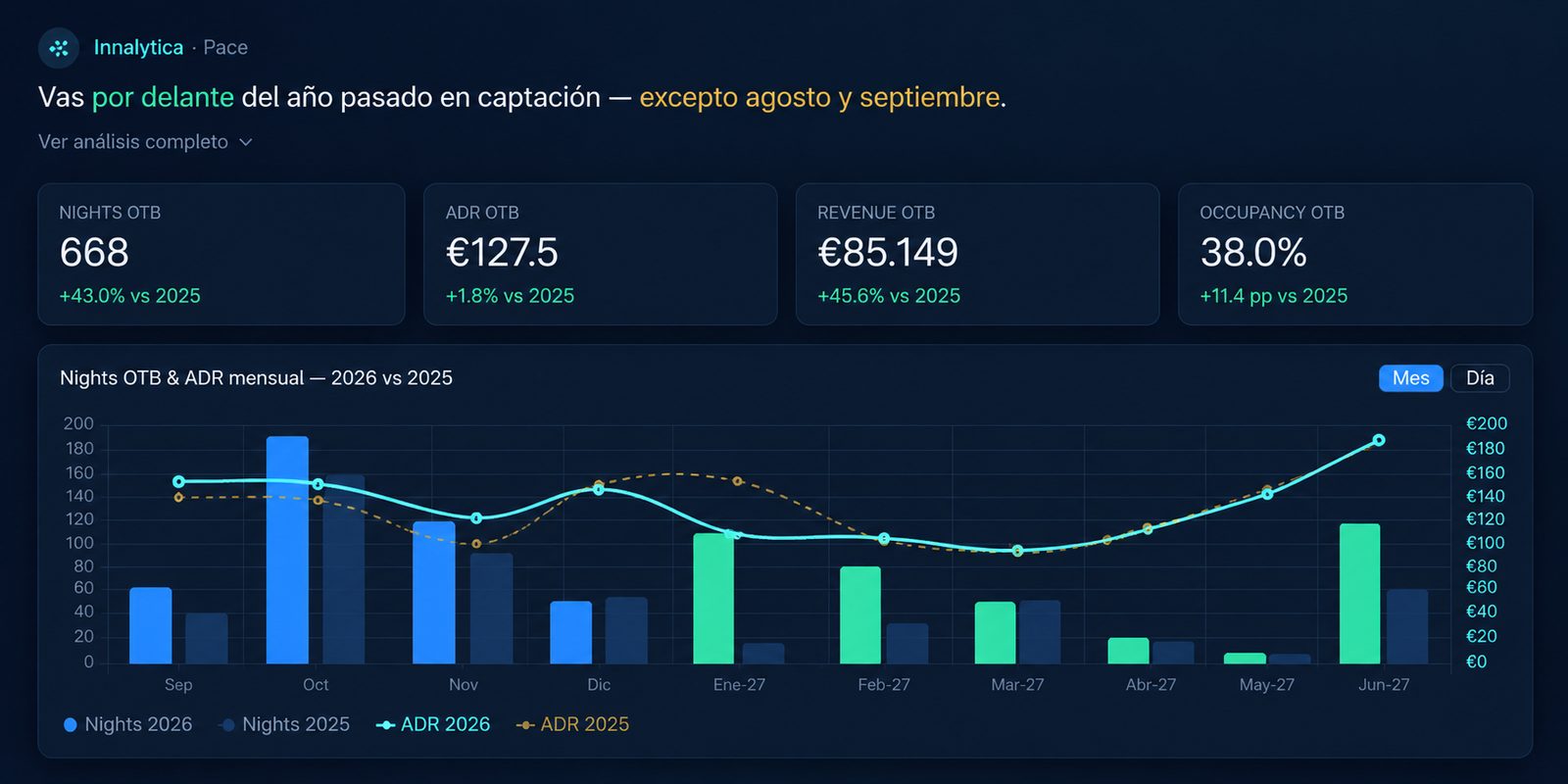
For many years, professionalising the management of an accommodation business meant, among other things, starting to measure.
Stopping making certain decisions on gut feeling alone and starting to look at occupancy, average rate, revenue, costs, production by channel, budgets, variances...
And that was a huge step forward.
The problem is that we've kept on adding information.
Today even a relatively small property may work with a PMS, channel manager, booking engine, OTAs, RMS, reputation tools, accounting, CRM, web analytics... Each system generates its own data and, usually, its own reports.
So we've gone from having little information to having a huge amount.
And yet we keep running into a fairly basic question:
What is really going on in the business?
The goal isn't to spend less time working on each business. It's to be able to spend more time on the things where we can genuinely add value.
Seeing what happened was the first step
Most of the tools we've worked with over the years are very good at explaining the past.
How much we sold. At what price. What occupancy we had. Which channel brought in the bookings. How the month closed. How we did against budget or against last year.
We need that information. Without it, managing well would be very difficult.
But it has an obvious limitation: by the time we see the result, it has often already happened.
We might find out that a month closed worse than expected, that a particular channel produced less, that a room type lost occupancy or that costs drifted off target.
All of that is useful for understanding what happened.
The next question is more interesting: could we have seen it sooner?
Data starts to be useful when it helps us spot things
For us, this is one of the big changes Business Intelligence needs to make.
It isn't simply about building better reports. It's about shortening the time between something starting to change in the business and the moment we're able to spot it.
Because many decisions have their moment.
If we see a shift in demand while we still have weeks ahead of us, we can act. If we find out at month-end that we sold less than expected, we can understand what happened, but we can no longer change that month.
And this doesn't only happen in Revenue.
It might be a cost that starts to drift, a difference in how room types are performing, a budget that stops being met or any change that, caught in time, lets us ask what's going on.
Understanding sooner gives us more options.
And the next step is even more interesting: not just spotting sooner what's already happening, but using all that information to start anticipating what might happen next.
Professionalising shouldn't mean spending more time preparing reports
This need doesn't only arise when you manage hundreds of properties.
It also arises when a single property starts to professionalise its management.
You want to understand the numbers better, compare periods, draw up budgets, track targets, analyse distribution, control costs or connect information that until then lived in different places.
And something paradoxical often happens: the more we want to understand the business, the more time we start spending preparing the information we need to understand it.
It happened to us.
For years we worked by downloading data from different systems, sorting it, cross-referencing it and building reports before we could really start analysing.
That's why we started developing our own tools. First MyReports and then Innalytica.
Not because we needed another place to look at charts. We wanted to spend less time preparing information and more time thinking, deciding and executing.
But we also wanted to win back time for something that matters even more to us: understanding the businesses we work with better.
When you don't have to spend hours building the report, you can spend those hours talking to the client, understanding what's changing, spotting new needs, questioning things that seemed to be working until then or identifying opportunities that may not show up directly on any dashboard.
Because data can teach us a lot about a business. But not everything that deserves our attention first shows up as a data point.
From explaining the past to helping us look ahead
For a long time, tools have mainly helped us see what has happened.
The next step is for them to help us more and more to understand what deserves our attention and why, so we can spend our time deciding what to do next.
And we need to go a little further.
We shouldn't settle for technology telling us that something went off track two weeks ago. We need tools that help us pick up signals, connect information and get ahead while there's still room to act.
That doesn't mean a tool has to make every decision for us.
It means it should help us get to the important questions sooner.
What's changing? Where? Since when? Is it a one-off or are we looking at a trend? What might happen if we carry on as we are? Is there something we should be doing differently?
See. Understand. Anticipate. Decide.
That journey sums up pretty well how we think hotel Business Intelligence should evolve.
- See what's happening.
- Understand what lies behind it.
- Anticipate where it might go.
- And then decide what we do.
The decision will still need context. You'll need to know the product, the market, the targets, the costs and, often, things that no dashboard can interpret on its own.
Technology can help us spot things sooner, understand them better and get ahead.
But it can also give us back something we've lost for years preparing information: time.
Time to think. To talk to the client. To understand what's changing in their business. To spot an opportunity we weren't looking for. To question a decision. To propose the next one.
Because the goal isn't to spend less time working on each business.
It's to be able to spend more time on the things where we can genuinely add value.